
Announcing the State of Global Youth Report 2025: Trust: Fractures & Opportunities for Youth
Posted OnFebruary 12, 2026 by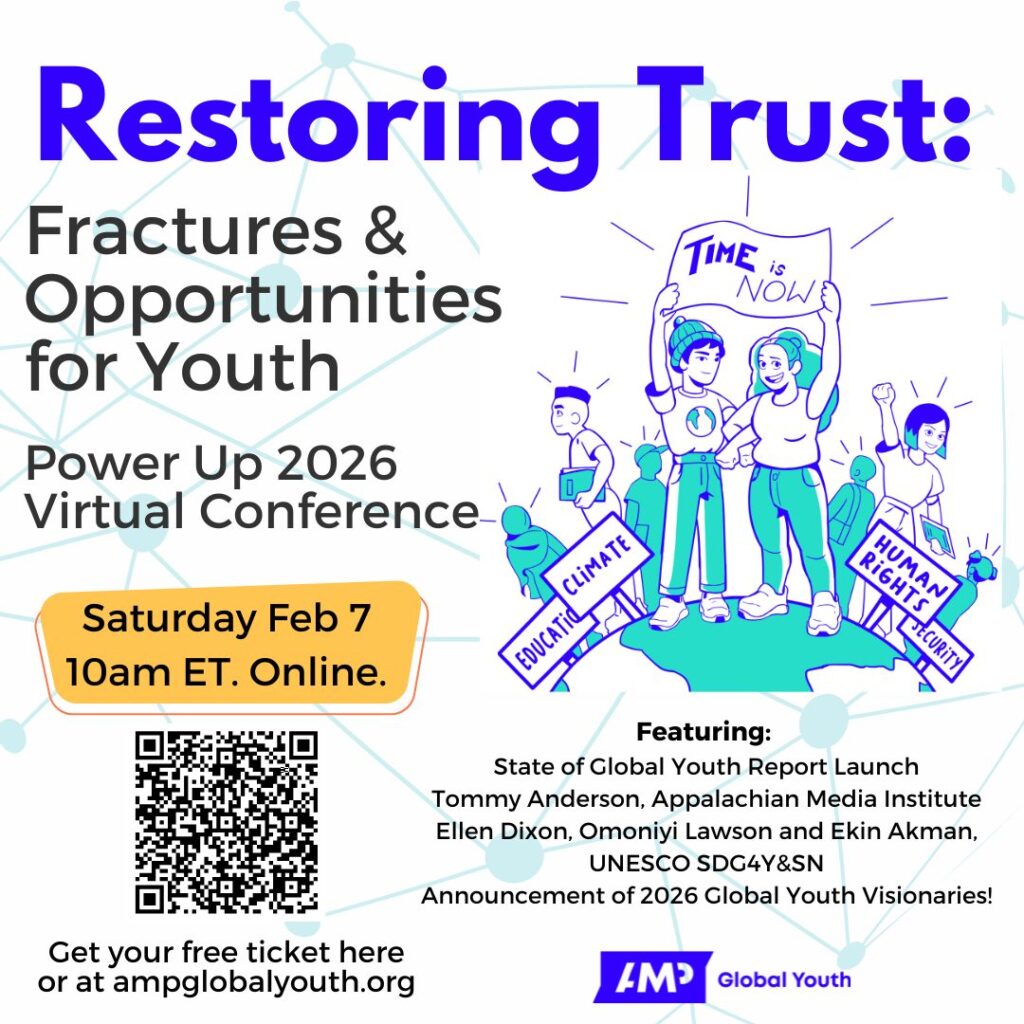
In a world fractured by division, disinformation, and distrust, young people are asking a fundamental question: How do we rebuild what has been broken?
At AMP Global Youth, we know that trust is not abstract—it is lived. It shapes whether a student believes their voice matters in a classroom, whether a young activist trusts institutions to deliver on climate promises, whether communities can come together across differences to solve problems. Trust is the foundation of the social fabric that holds us together. And right now, that fabric is fraying.
The 2025 State of the Global Youth Report confronts this crisis head-on. We explore:
- How do young people experience and define trust in today’s world?
- Where is trust breaking down—and where are youth working to repair it?
- What role can young people play in rebuilding our social fabric?
Our research spans critical domains from civic engagement to media literacy, from community organizing to institutional accountability. By centering youth voices and lived experiences, this report reveals how today’s young people navigate an era of unprecedented polarization, technological disruption, and social fragmentation—and how they are building new models of connection, credibility, and collective action.
This report is more than just data. It is a call to action—for policymakers seeking to restore faith in institutions, for educators building spaces where young people can develop critical thinking and civic skills, for community leaders fostering connection across divides, and for young people themselves who are already doing the work of repair.
We invite you to join us. Whether you’re working to strengthen democratic institutions, build more trustworthy media ecosystems, create inclusive communities, or simply seek to understand how this generation sees the world, the State of the Global Youth Report is here as a resource to inform, inspire, and mobilize.
Because we believe that young people are not just inheriting a fractured world—they are already working to mend it. And they are the ones we’ve been waiting for.
Read the full Report here. Scroll down for highlights!
Part 1: What is Trust?
Youth most strongly associate trust with core integrity and relational values, forming a clear top cluster led by honesty (75%), respect (64%), loyalty (60%), and transparency (58%). These results suggest that, for young people, trust is fundamentally rooted in truthfulness, mutual regard, and consistency between words and actions rather than authority or status.
A middle tier centers on emotional safety and dependability—including authenticity, support, understanding, reliability, and communication—indicating that trust is reinforced through feeling heard, protected, and able to rely on others over time.
The lowest-ranked values—such as reputation, diversity, and boundaries—are still meaningful but appear more contextual, suggesting youth view trust less as a formal or institutional construct and more as a lived, relational experience grounded in everyday human behavior.
Part 2: Who do youth trust?
The data demonstrates that in the minds of young people worldwide, there is clearly a trust pyramid, where personal relations reign supreme (7.77 for friends, 8.24 for family, etc.), followed by immediate service providers such as medical practitioners (7.01) and teachers (6.43), and organizations and data sources bring up the rear, the latter scoring as low as social media applications, which range from 2.13 to 4.17, and political entities averaging between 3.0 and 3.8. The principle of proximity is demonstrated through the high correlation of personal trust.
On regional levels, Brazil presents a consistently high degree of trust in interpersonal and community institutions but at the same time an abnormally low political trust, while Syria exhibits selective trust, where hands-on service providers are preferred to more abstract national institutions; in Russia, there is a general institutional skepticism, which is especially acute when applied to religious leaders and independent journalists, while in the US, there is above-average trust in local schools, local officials, and healthcare, yet steep declines for national politics and social media.
However, the thread that runs through all of these is that the youth trust people they know or people that work directly with individuals far more than they trust systems, platforms, or any political structure, which may highlight the personal nature of trust in 2025. This is of profound significance because the implications are that trust does not reside within systems or structures of authority, and that trust can only be built through continuous personal interactions at the hands of competent individuals.
Part 3: How can we build trust?
When asked how to actually build trust, young people prioritize actionable behaviors over abstract values: honesty leads overwhelmingly (72 responses), followed by reliability (50), understanding (43), communication (29), and emotional safety (28), while traditional institutional safeguards like boundaries (3), confidentiality (5), and even competence (5) barely register. This ranking reveals a pragmatic wisdom—respondents recognize that trust isn’t built through policies or credentials but through consistent, authentic human behavior.
The relatively high emphasis on familiarity and repeated interaction (27) underscores that trust requires time and sustained presence, not one-off gestures. Context matters significantly in application: for schools, students prioritize accountability and confidentiality (wanting assurance that sharing won’t lead to punitive consequences), plus boundaries that establish mutual respect between teachers and students.
For news and social media, honesty and unbiased presentation dominate concerns. For personal relationships, no judgment and clear boundaries emerge as foundational, while for elected officials, communication that demonstrates genuine listening and understanding of diverse community needs takes precedence.
The gap between what young people say builds trust (honesty, reliability, understanding) and what institutions typically offer (competence credentials, official policies, hierarchical authority) explains much of the trust deficit revealed in the rankings data. The pathway forward is clear but demanding: institutions must shift from broadcasting authority to demonstrating consistency, from claiming expertise to showing understanding, and from expecting deference to earning trust through transparent, accountable, repeated positive interactions that prove—not proclaim—trustworthiness.
Action Plan:
Following are initial thoughts on how we can build trust within education spaces, youth programs, and our broader political and civic spaces. This conversation is ongoing. Please add your thoughts on how to build trust here, and we’ll include them with updated recommendations in the coming weeks.
For Educational Institutions
- Create structured touchpoints for reliability demonstration. Establish office hours, predictable response times for emails, and clear expectations for assignment feedback. When educators consistently follow through on these commitments, they build the reliability that students value most. Additionally, develop professional development workshops specifically focused on creating emotionally safe classrooms—teaching educators how to balance support with appropriate boundaries, as the research suggests both matter but in different ways.
- Implement “trust audits” where students anonymously rate which trust dimensions they experience in their learning environment. Use this data to identify gaps between what students value (reliability, support) and what they perceive they’re receiving. Create accountability mechanisms for improving low-rated areas, such as peer observation programs where teachers observe each other specifically for trust-building behaviors.
For Community Organizations & Youth Programs
- Design programs that explicitly teach the context-dependent nature of trust. Help young people understand when to prioritize different trust elements—seeking emotional safety in friendships while demanding transparency from institutions. This metacognitive approach empowers youth to make more intentional decisions about where to place their trust and what to expect in return.
- Establish mentorship programs that model reliable support. Pair young people with adults who commit to specific, achievable touchpoints (weekly check-ins, responding to messages within 24 hours) rather than vague promises of availability. Track mentor follow-through as a key program metric, recognizing that reliability is foundational to all other trust dimensions.
For Civic Engagement & Political Participation
- Launch transparency initiatives that directly address the honesty gap. Create platforms where elected officials publicly commit to specific actions and where constituents can track follow-through. The data shows young people value reliability in leaders (22%), but current political structures rarely make accountability visible or accessible.
- Develop civic education curricula that explicitly address trust in information systems. Given that 46% of respondents prioritize reliability for information sources and 37% emphasize competence, teach young people practical skills for evaluating source credibility, cross-referencing claims, and identifying bias. Include units on the business models of news organizations and social media platforms to help students understand structural incentives that may compromise trustworthiness.
For Digital Literacy & Media Programs
- Create “trust triangulation” workshops based on respondents’ emphasis on corroborating information across sources. Teach students systematic approaches to verification rather than relying on single sources, addressing their concern about misinformation and manipulation in social media contexts.
- Partner with content creators and influencers who model transparency about sponsorships, corrections when they’re wrong, and authentic representation of both successes and failures. The quotes reveal that young people value authenticity (“their online image isn’t fake: they don’t hide their failures”) and can detect manipulation, so elevate examples of trustworthy digital communication.
THANKS to the State of Global Youth Report 2026 Team!
Susie Coakley
Axel Treitel-Knapp
Alina Niskoromnykh
Arwa Haloul
Saadallah Mansour
Eliana Gardner
Alexander Doyle
Claire Witalec
Tanya Mishra
Daniel Ohr
Robi Castaneda
Nethra Krishnan
Kamila Sarsembay
Karen Showalter (advisor)
Lara Guioto
Victor Ramos Dessaune
Lucas Oliveira
This team hailed from across the US, Syria, Russia and Brazil, and worked together virtually over the past 6 months to define our research questions, gather data, distill findings, and write the report.
Support this work!
The State of Global Youth Report is an all-volunteer effort. Help us ensure this work continues, and grows. We need more support to offer stipends to our youth leaders, disseminate the report to youth leaders and allies, and organize future launch events. Any amount helps — make a contribution here.
Reach out to Opportunities@AMPGlobalYouth.org or Karen@AMPGlobalYouth.org to discuss partnerships and sponsorships of the State of Global Youth Report.