Snapshot: Key Findings and Highlights
Across countries, generations, and institutions, trust feels thinner than it once did. Political polarization is no longer an abstract concept; it shapes how people speak, how they listen, and how often they choose to disengage altogether. Public discourse has grown louder but emptier. Social media keeps us constantly connected, yet rarely close. Institutions remain in place, but belief in them has quietly eroded. What once held us together now feels fragile, and easily torn.
For young people, this erosion of trust is not theoretical. It is lived. It appears in classrooms where voices are dismissed, in news feeds that feel disconnected from reality, and in institutions that speak about youth without ever speaking with them. Declining trust in political systems and media is often mislabeled as apathy, when it is more accurately the result of exclusion and unmet expectations. For youth, trust is not built through promises or slogans, but through fairness, transparency, and the experience of being genuinely heard.
Trust, however, does not belong to institutions alone. It grows through relationships, shared spaces, and small, repeated acts of care. Writers like David Brooks and Frederick Riley describe the role of “weavers” in the social fabric: individuals who nurture empathy and connection in everyday spaces such as schools, community centers, and local gatherings. When these spaces disappear or become inaccessible, trust weakens. Rising loneliness, declining civic participation, and widening generational divides are not separate crises, but interconnected symptoms of the same slow unraveling.
Yet trust has not disappeared. It has become selective and conditional. Young people place their trust where participation is real and agency is shared: in classrooms that invite dialogue, in community initiatives grounded in care, and in spaces where voices are not only acknowledged but taken seriously. Where inclusion exists, trust has room to grow.
The 2025 State of Global Youth Report situated itself in this fractured world, asking not only how trust has eroded, but how youth understand, locate, and imagine repairing it. This report draws on both lived experiences and research insights, showing that youth are not mere witnesses; they are the active weavers of what comes next. Explore the full report here.
Key findings:
1. What is Trust?
The State of Global Youth Report (SOGY) 2025 data reveals a sophisticated, context-dependent understanding of trust among young people. Rather than applying a single definition universally, respondents demonstrate nuanced thinking about what trust means in different relationships and institutions. This suggests that trust-building interventions must be tailored to specific contexts rather than applying one-size-fits-all approaches.
The stark contrast between interpersonal and institutional trust is particularly revealing. In personal relationships, young people seek reliability and emotional support—they want people who show up consistently and create safe spaces for authentic self-expression. However, when evaluating public figures, institutions, and information sources, the emphasis shifts dramatically toward honesty, transparency, and competence. This shift reflects an awareness that different relationships serve different purposes: friends and family provide emotional sustenance, while institutions and public figures must demonstrate integrity and expertise.
The regional variations add another layer of complexity. The data suggests that cultural context shapes not just what people trust, but how they conceptualize trust itself. Syrian respondents’ overwhelming emphasis on honesty in the public sphere (78%) may reflect experiences with government censorship or propaganda. Brazilian respondents’ consistent prioritization of reliability across contexts could indicate cultural values around dependability and follow-through. These differences remind us that trust is not merely an individual psychological phenomenon but a social and cultural one, shaped by collective experiences and historical contexts.
Perhaps most concerning are the gaps in what young people expect from institutions. The low prioritization of confidentiality with educators (3%) suggests either that students don’t expect privacy protections or that they’ve normalized the absence of such protections. Similarly, the minimal emphasis on fairness/equity for elected officials (4%) may indicate either that young people don’t expect fair treatment from the government or that they conceptualize trust separately from justice. These gaps represent both challenges and opportunities for institutional reform.
2. Who do youth trust?
The data demonstrates that in the minds of young people worldwide, there is clearly a trust pyramid, where personal relations reign supreme (7.77 for friends, 8.24 for family, etc.), followed by immediate service providers such as medical practitioners (7.01) and teachers (6.43), and organizations and data sources bring up the rear, the latter scoring as low as social media applications, which range from 2.13 to 4.17, and political entities averaging between 3.0 and 3.8. The principle of proximity is demonstrated through the high correlation of personal trust.
On regional levels, Brazil presents a consistently high degree of trust in interpersonal and community institutions but at the same time an abnormally low political trust, while Syria exhibits selective trust, where hands-on service providers are preferred to more abstract national institutions; in Russia, there is a general institutional skepticism, which is especially acute when applied to religious leaders and independent journalists, while in the US, there is above-average trust in local schools, local officials, and healthcare, yet steep declines for national politics and social media.
However, the thread that runs through all of these is that the youth trust people they know or people that work directly with individuals far more than they trust systems, platforms, or any political structure, which may highlight the personal nature of trust in 2025. This is of profound significance because the implications are that trust does not reside within systems or structures of authority, and that trust can only be built through continuous personal interactions at the hands of competent individuals.
3. How can we build trust?
When asked how to actually build trust, young people prioritize actionable behaviors over abstract values: honesty leads overwhelmingly (72 responses), followed by reliability (50), understanding (43), communication (29), and emotional safety (28), while traditional institutional safeguards like boundaries (3), confidentiality (5), and even competence (5) barely register. This ranking reveals a pragmatic wisdom—respondents recognize that trust isn’t built through policies or credentials but through consistent, authentic human behavior.
The relatively high emphasis on familiarity and repeated interaction (27) underscores that trust requires time and sustained presence, not one-off gestures. Context matters significantly in application: for schools, students prioritize accountability and confidentiality (wanting assurance that sharing won’t lead to punitive consequences), plus boundaries that establish mutual respect between teachers and students.
For news and social media, honesty and unbiased presentation dominate concerns. For personal relationships, no judgment and clear boundaries emerge as foundational, while for elected officials, communication that demonstrates genuine listening and understanding of diverse community needs takes precedence.
The gap between what young people say builds trust (honesty, reliability, understanding) and what institutions typically offer (competence credentials, official policies, hierarchical authority) explains much of the trust deficit revealed in the rankings data. The pathway forward is clear but demanding: institutions must shift from broadcasting authority to demonstrating consistency, from claiming expertise to showing understanding, and from expecting deference to earning trust through transparent, accountable, repeated positive interactions that prove—not proclaim—trustworthiness.

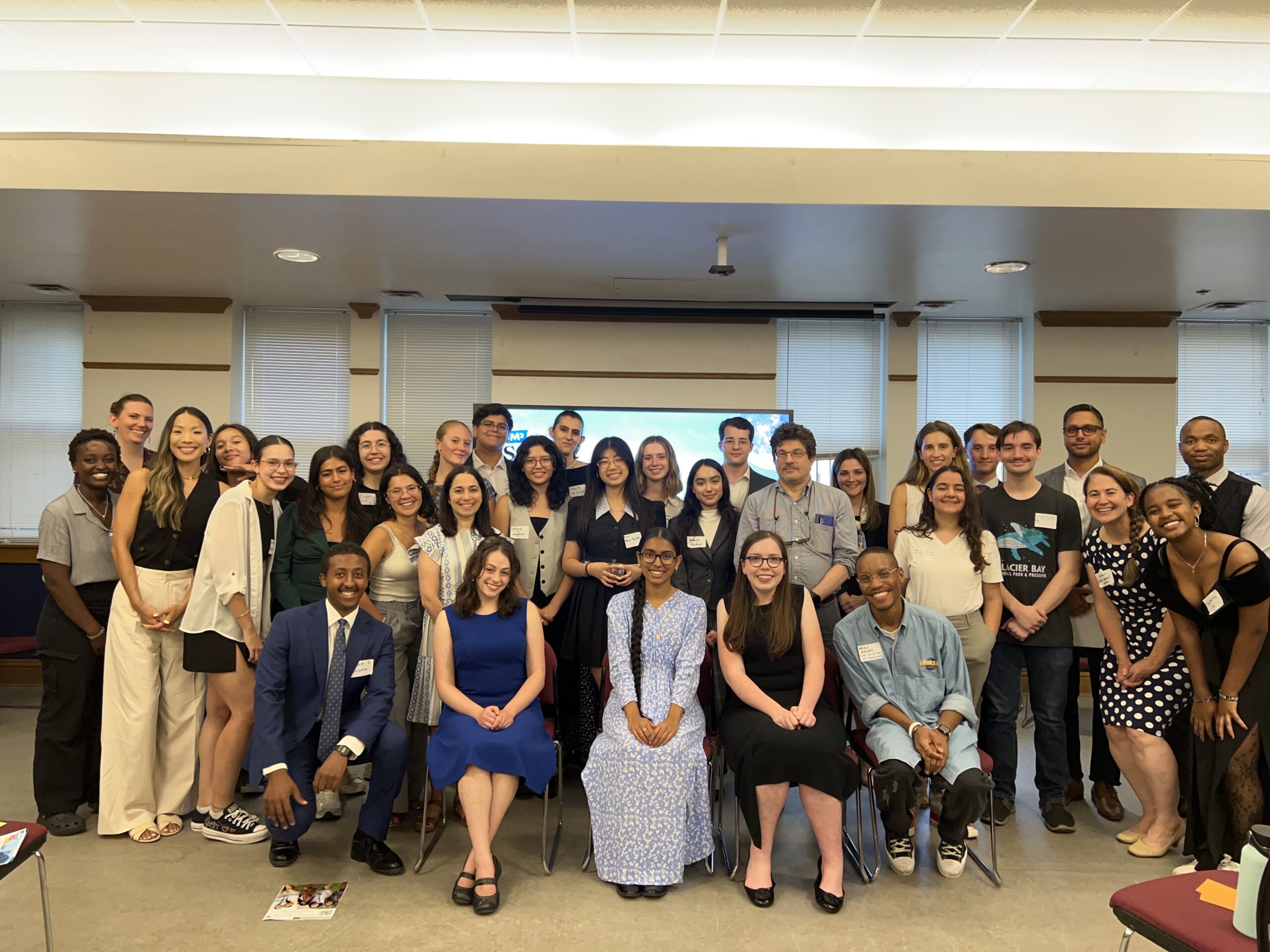 AMP Global Youth leaders, board members, partners and special guests at the State of Global Youth Report launch at Georgetown University in Washington, DC